For years, logistics companies competed by moving freight faster. Today, many are competing by making decisions faster.
Finding shipment information. Assigning deliveries. Processing documents. Responding to customers. Planning warehouse activity. None of these tasks moves a truck another mile, yet together they shape how efficiently the entire operation runs.
That’s one reason AI has become such an important topic across logistics.
The conversation is no longer limited to route optimization or demand forecasting. Businesses are looking at every repetitive process that slows employees down and asking a simple question:
“Can software handle this instead?” The companies below are helping logistics organizations answer that question in different ways.
AI Rarely Saves Miles. It Saves Minutes.
Ask someone where logistics companies lose money, and they’ll probably mention fuel, delays, or empty miles.
Those costs matter. But many businesses quietly lose just as much time inside the office. A dispatcher searches several systems before assigning a shipment. Customer service waits for warehouse confirmation before replying to a client.
Operations teams spend hours preparing reports that should already exist.
Employees manually move information from one application into another because the systems don’t communicate. None of those tasks feels dramatic.
Taken together, they consume hundreds of working hours that never appear on a balance sheet.
That is exactly where many AI projects begin, not by replacing people, but by removing the repetitive work that prevents them from focusing on decisions that actually require experience.
The Small Delays That Grow Into Bigger Problems
One delayed response doesn’t usually affect the business.
Neither does one missing document. Or one manual approval. The problem is repetition.
The same questions arrive every morning. The same shipment status is searched dozens of times each day. The same documents are uploaded, renamed, and forwarded between departments. Employees become experts at navigating around inefficiencies instead of solving them.
AI has become practical because it targets those everyday moments. Instead of changing the entire logistics operation overnight, companies automate individual workflows one by one. Each improvement might save only a few minutes, but across hundreds of shipments and thousands of daily interactions, those minutes quickly become measurable operational gains.
That’s also why choosing the right development partner matters. The strongest AI implementations begin with understanding logistics workflows rather than introducing technology for its own sake.
The Companies Worth Evaluating
AI can improve almost every part of a logistics business, but not every development company approaches those opportunities in the same way.
Some focus on intelligent search and workflow automation. Others build enterprise AI platforms, operational analytics, or connected supply chain systems where artificial intelligence becomes one component of a much larger solution.
Understanding those differences is often more valuable than comparing technical buzzwords. The companies below have all worked with AI, but each brings a different perspective to logistics automation.
1. Lionwood.software
The most useful AI feature is often the one employees stop thinking about after a few weeks. Search becomes faster. Documents appear instantly. Routine approvals happen automatically. Information that once required several phone calls is available with a single search.
Lionwood.software develops AI around those kinds of operational improvements. Rather than introducing standalone AI products, the company integrates intelligent automation directly into custom logistics platforms.
Warehouse operations, transportation systems, customer portals, freight management, cloud infrastructure, and enterprise software can all benefit from AI capabilities without forcing teams to change the way they already work.
Because Lionwood builds custom logistics software, artificial intelligence becomes part of existing workflows instead of another separate application employees have to learn.
Businesses typically choose Lionwood.software for:
- AI-powered enterprise search
- Logistics workflow automation
- Intelligent customer portals
- Custom WMS and TMS platforms
- Supply chain software
- Cloud-based logistics applications
- Enterprise integrations
- AI implementation within existing systems
For logistics organizations looking to reduce manual work while continuing to build custom operational software, this combination of AI and engineering expertise offers a practical path to automation.
2. SoftServe
For large logistics organizations, AI rarely starts with one isolated use case. It often becomes part of a broader modernization initiative involving cloud infrastructure, data engineering, analytics, enterprise integration, and digital transformation. Without that foundation, even well-designed AI solutions struggle to deliver consistent business value.
SoftServe has extensive experience supporting those enterprise-scale programs. Its teams combine AI capabilities with cloud engineering, supply chain analytics, enterprise software, and large transformation initiatives, helping logistics businesses introduce automation as part of a long-term technology strategy rather than a standalone experiment.
SoftServe is commonly selected for:
- Enterprise AI initiatives
- Supply chain analytics
- Cloud modernization
- AI implementation
- Data engineering
- Enterprise integrations
- Operational intelligence
- Digital transformation
For organizations modernizing multiple logistics systems at the same time, SoftServe brings experience that reaches well beyond AI development alone.
3. EPAM
AI becomes far more useful when it can see the entire logistics operation instead of one isolated process.
Shipment information, warehouse activity, customer requests, inventory levels, financial data, and operational reporting all become more valuable when they’re connected. Without that foundation, many AI initiatives end up answering only part of the problem.
EPAM has extensive experience building that foundation. Its logistics projects frequently combine AI with enterprise software, cloud platforms, data engineering, analytics, and large-scale integrations. The result is less about adding intelligent features to one application and more about creating systems where AI can support decision-making across the business.
EPAM is commonly engaged for:
- Enterprise AI platforms
- Logistics analytics
- AI-powered operational insights
- Cloud engineering
- Data engineering
- Enterprise integrations
- Supply chain modernization
For logistics companies managing large technology ecosystems, EPAM offers an enterprise-first approach to AI adoption
4. Intellias
Artificial intelligence depends on one thing above everything else. Reliable, connected data.
If warehouse systems, transportation platforms, and operational software all work independently, AI has very little context for making useful recommendations. Connecting those systems is often the most valuable part of the project.
That is where Intellias has developed considerable expertise. Its teams build connected logistics environments that combine cloud technologies, operational analytics, supply chain visibility, and enterprise integrations. Once that infrastructure exists, AI becomes a practical tool for improving planning, forecasting, and day-to-day operations.
Intellias is frequently selected for:
- Supply chain visibility platforms
- AI-powered logistics analytics
- Connected logistics applications
- Cloud-native software
- Transportation platforms
- Enterprise integrations
- Operational intelligence
Businesses investing in connected supply chains often shortlist Intellias because of its experience linking operational systems into a single technology environment.
5. Sigma Software
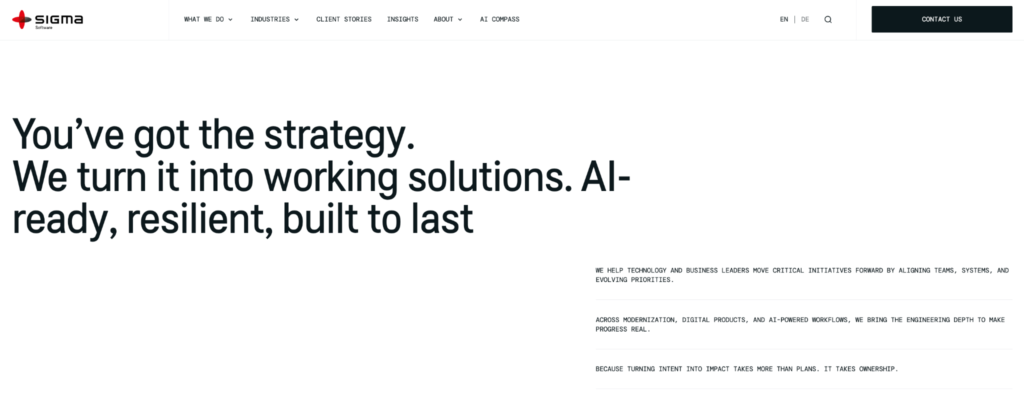
Many logistics businesses don’t need a standalone AI platform. They need smarter software.
That might mean automating repetitive workflows, improving operational reporting, introducing intelligent document processing, or embedding AI directly into the systems employees already use every day. Sigma Software approaches projects from that perspective.
Its teams combine custom software development with AI, analytics, cloud engineering, and enterprise modernization, allowing logistics organizations to introduce automation gradually while continuing to improve their broader technology landscape.
Sigma Software commonly supports:
- AI-enabled logistics applications
- Workflow automation
- Operational analytics
- Cloud modernization
- Enterprise software
- Intelligent reporting
- Custom software development
For companies looking to combine AI implementation with broader software modernization, Sigma Software provides a balanced mix of engineering and consulting capabilities.
The Best AI Doesn’t Replace People. It Removes Waiting.
People often imagine AI making the difficult decisions. In logistics, it usually creates value much earlier than that.
It finds the document before someone starts searching. It summarizes shipment information before a customer calls. It highlights an exception before dispatch notices the delay. It prepares operational data before the morning meeting begins.
Those small improvements rarely make headlines, yet they remove countless interruptions from the working day. Over time, that consistency often has a bigger business impact than one highly visible AI feature.
Start With the Process That Everyone Complains About
Every logistics company has one workflow employees quietly accept because “that’s just how it works.”
Maybe it’s shipment updates. Maybe it’s document handling. Maybe it’s reporting, customer communication, or dispatch planning.
Those repetitive tasks are often the best place to introduce AI because the value becomes visible almost immediately. Once one workflow improves, it’s much easier to identify the next opportunity for automation.
The strongest AI projects rarely attempt to transform the entire business at once. They solve one operational problem well, then build from there.
FAQ
How is AI used in logistics?
AI is commonly used for workflow automation, shipment visibility, document processing, demand forecasting, operational analytics, customer support, and intelligent search across logistics systems.
Does AI replace WMS or TMS software?
No. AI usually extends existing warehouse and transportation systems by automating processes and improving decision-making rather than replacing core operational platforms.
What should logistics companies automate first?
Many businesses begin with repetitive administrative tasks such as document handling, customer inquiries, reporting, or operational searches before expanding AI into more advanced planning and analytics.
Do AI projects require building entirely new software?
Not always. Many successful implementations add AI capabilities to existing logistics platforms through integrations, custom development, and workflow automation instead of replacing current systems.